
Doctor on Wheels: The Physician Who Decided Healthcare Should Come Home
Doctor on Wheels: The Physician Who Decided Healthcare Should Come Home
By all conventional measures, Dr. Swaminathan Chandramouli had a successful career ahead of him. Trained in emergency medicine, he worked in intensive care units where every second mattered and every decision could determine whether a patient lived or died. Yet, amid the sophisticated equipment, specialist teams, and high-pressure environment, he noticed a quieter tragedy unfolding every day—one that rarely made headlines.
It wasn't always disease that defeated patients.
Sometimes, it was simply the journey to the hospital.
For elderly Indians, particularly those living with multiple chronic illnesses, getting to a doctor can be an ordeal. A short consultation often requires arranging transport, lifting frail parents into vehicles, waiting in crowded outpatient departments, navigating multiple hospital floors, and enduring hours of exhaustion for barely ten minutes with a physician.
Many families postponed appointments because they simply could not manage the logistics.
Others ignored worsening symptoms until a medical emergency forced hospitalization.
Dr. Chandramouli began asking a question that sounded deceptively simple
If groceries, food, and medicines can be delivered to someone's doorstep, why can't a doctor?
That question would eventually become one of India's most innovative models of community healthcare.
A Different Definition of Healthcare
Born in Tiruchirappalli and raised in Canada by his single mother after his parents separated, Chandramouli spent much of his childhood between two very different healthcare systems.
When he returned to India in 2006 to study medicine, he expected to build a career as an emergency physician. He completed his MBBS, specialized in emergency medicine, and joined a private hospital where he worked in intensive care.
Inside the ICU, he witnessed remarkable recoveries.
But he also witnessed heartbreaking failures—not because medicine lacked answers, but because patients reached hospitals too late or could not afford prolonged treatment.
The elderly suffered the most.
Many were admitted with complications that could have been prevented through regular monitoring at home.
The problem wasn't always medical.
It was access.
Building a Hospital Inside a Van
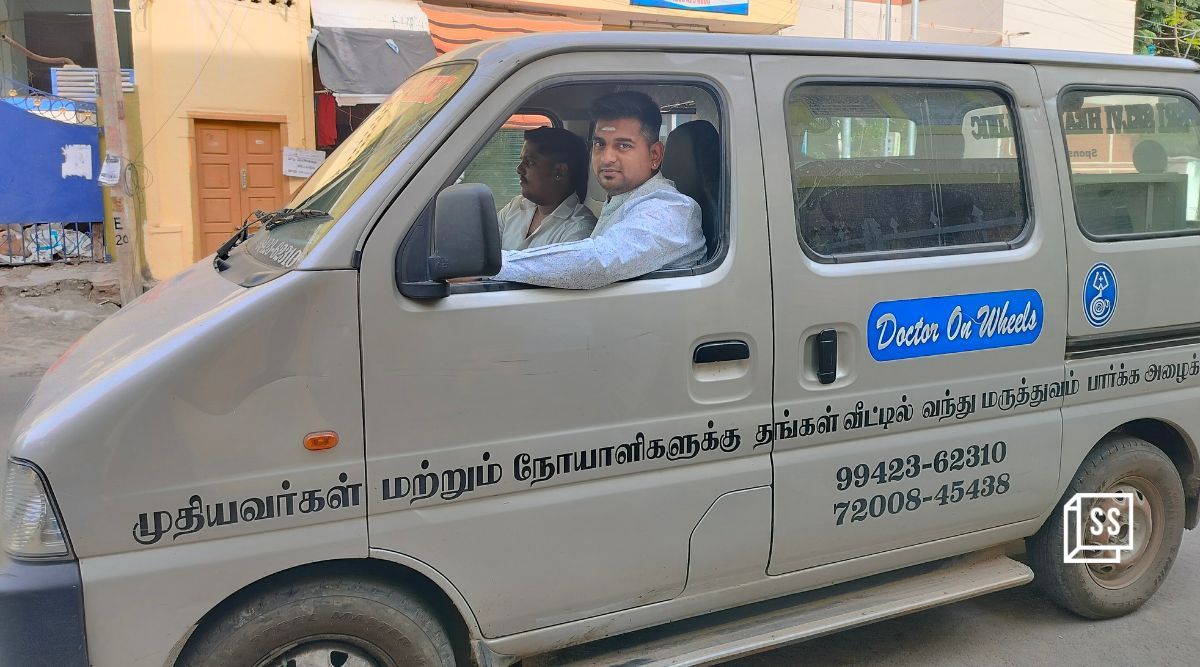
In 2019, Chandramouli resigned from corporate practice and launched Doctor on Wheels in Madurai.
His clinic wasn't a building.
It was a modified Maruti Eeco ambulance.
Inside the compact vehicle, he installed equipment normally associated with emergency care
Oxygen cylinders
Infusion pumps
Syringe drivers
Portable ECG
Emergency medicines
Diagnostic equipment
Equipment for blood collection
Portable imaging support
Rather than asking patients to travel, his team travelled to them.
For bedridden patients, people with disabilities, and senior citizens, the van effectively became a mobile outpatient department.
Medicine at the Kitchen Table
Unlike busy hospitals where doctors may have only a few minutes per patient, Chandramouli intentionally slowed the process.
Every visit was different.
Sometimes he treated infected bedsores.
Sometimes uncontrolled diabetes.
Sometimes urinary infections.
Sometimes he simply listened.
Many elderly patients were living alone while their children worked in Bengaluru, Mumbai, Dubai, London, or Toronto.
The consultation often became as much about emotional reassurance as clinical care.
He has frequently described elderly patients as "big babies"—not to diminish them, but to emphasize that they need patience, affection, and someone willing to hear their concerns rather than rushing through an appointment.
A Family's Lifeline
One of the many families transformed by the initiative was that of Prabhakar Rao.
His 83-year-old mother struggled with age-related illnesses that made repeated hospital visits physically draining.
Every appointment required enormous effort.
When Doctor on Wheels began visiting their home every few weeks, routine healthcare became exactly what it should have been—routine.
Instead of arranging transportation, waiting in queues, and risking infections inside crowded hospitals, she received comprehensive care in the familiarity of her own home.
For families like the Raos, this wasn't simply convenient.
It restored dignity.
More Than House Calls
The service quickly expanded beyond routine consultations.
Today, Doctor on Wheels offers
Comprehensive physician consultations
Home nursing support
Physiotherapy
Palliative care
Blood sample collection
Medication delivery
Portable diagnostics
Post-hospitalization follow-up
Chronic disease management
When necessary, patients are stabilized and referred to hospitals.
The initiative was never designed to replace hospitals.
It was designed to prevent avoidable hospitalizations.
Growth Through Trust
The first months were uncertain.
Few people believed a young doctor travelling in a van could provide quality care.
Initially, the initiative handled only a handful of cases each month.
Word spread slowly.
Families recommended the service to neighbours.
Patients who recovered became ambassadors.
Within a few years, Doctor on Wheels was managing around 600 patient visits each month, with a multidisciplinary team that includes nurses, physiotherapists, physician assistants, radiology support, outreach staff, and drivers. Since its launch, the initiative has served more than 25,000 elderly patients.
Compassion Still Has a Business Model
Unlike many charitable healthcare initiatives, Doctor on Wheels attempts to remain financially sustainable.
Patients who can afford to pay are charged modest consultation and travel fees based largely on distance.
Those who cannot pay are often treated free of charge.
This cross-support model allows the service to continue operating without compromising its mission.
It is a reminder that social impact does not always require choosing between charity and sustainability.
Sometimes it requires balancing both.
A New Vision of Ageing
India's elderly population is growing rapidly.
Millions of senior citizens live with diabetes, hypertension, arthritis, dementia, heart disease, or reduced mobility.
Healthcare systems have traditionally been built around hospitals.
Doctor on Wheels asks a different question
What if healthcare were built around patients?
Its model shifts the centre of gravity from institutions to communities.
Instead of measuring success by hospital admissions, it measures success by keeping people healthy enough to stay home.
The Road Ahead
Chandramouli has spoken about expanding the concept into integrated elderly care centres and encouraging more physicians to embrace community-based medicine. His vision is not simply to add more vehicles but to reshape how India thinks about caring for an ageing population.
Whether that vision spreads nationally remains to be seen.
But every morning, as a white medical van leaves its base in Madurai carrying oxygen cylinders, medicines, diagnostic equipment, and a doctor willing to drive wherever he is needed, it quietly challenges one of healthcare's oldest assumptions.
Perhaps the future of medicine is not always a bigger hospital.
Sometimes, it is a doctor knocking on your front door.