
Ambulance Dada: The Tea Garden Worker Who Built an Ambulance Service With a Motorcycle
Ambulance Dada: The Tea Garden Worker Who Built an Ambulance Service With a Motorcycle
By all accounts, Karimul Haque should never have become a healthcare hero.
He was not a doctor.
He had never attended medical school.
He did not own an ambulance.
He had no government funding, no NGO backing, and no wealthy philanthropist writing cheques to support his work.
For most of his life, he earned barely enough to survive as a labourer in a tea garden in northern West Bengal. Every day began before sunrise, with hours spent plucking tea leaves under an unforgiving sun. Like thousands of others in the region, his life was defined by hard work, modest income, and limited opportunities.
Yet today, in dozens of villages surrounding Jalpaiguri, people know him by only one name.
Ambulance Dada.
For more than three decades, whenever someone's life hangs in the balance—a woman in labour, a child with a high fever, a snakebite victim, or an elderly man suffering a heart attack—villagers don't dial an ambulance first.
They call Karimul.
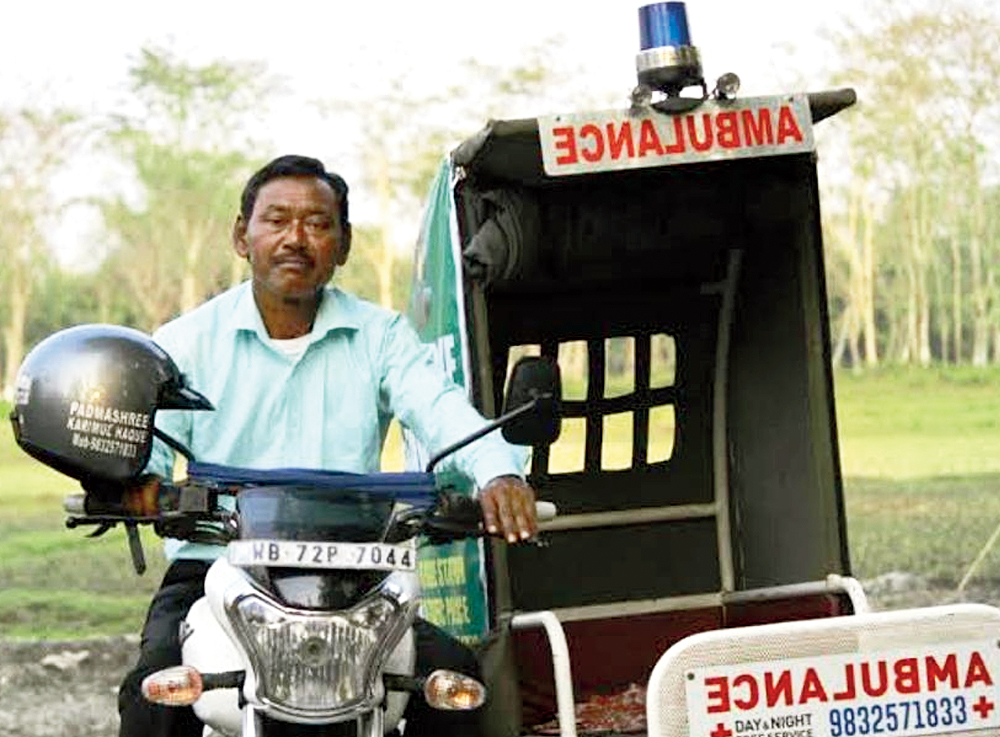
Within minutes, the unmistakable sound of his motorcycle echoes through narrow village roads. A stretcher is fastened to the side. A frightened family climbs aboard. Then begins a race against time toward the nearest hospital.
It is one man, one motorcycle, and one unwavering belief: no one should die simply because help could not arrive in time.
A Personal Tragedy That Changed Everything
Every remarkable story begins with a defining moment.
For Karimul Haque, that moment arrived in the early 1990s.
His mother fell seriously ill while working in the fields near their village.
The nearest hospital was miles away.
There was no ambulance.
There was no emergency transport.
Neighbours desperately searched for a vehicle, but precious time slipped away. By the time she finally reached medical care, it was too late.
She died before doctors could save her.
For most people, such a tragedy becomes a painful memory.
For Karimul, it became a lifelong mission.
Standing beside his mother's body, he made a promise to himself.
If he could not save her, perhaps he could save someone else's mother.
The Geography of Neglect
To understand why Karimul's work matters, one must first understand the landscape he serves.
The villages around Jalpaiguri are surrounded by tea estates, forests, rivers, and uneven rural roads. Many settlements lie several kilometres from the nearest primary health centre, while advanced hospitals are much farther away.
During the monsoon, roads disappear beneath floodwaters.
At night, transportation becomes even scarcer.
Years ago, calling an ambulance was often meaningless because none could reach these villages quickly enough.
For emergencies, families relied on bicycles, bullock carts, improvised stretchers, or sheer luck.
For trauma victims, pregnant women, and heart attack patients, every delay reduced the chances of survival.
Karimul knew this reality intimately because he lived it.
An Unlikely Ambulance
He could never afford a conventional ambulance.
But he did own something else.
A motorcycle.
What others saw as ordinary transportation, Karimul saw as a lifesaving machine.
He modified the motorcycle so that a patient could be transported safely while accompanied by a family member. The design was simple rather than sophisticated, but it solved the one problem that mattered most: getting people to a hospital as quickly as possible.
Whenever the phone rang, he dropped everything.
Tea garden work.
Meals.
Family gatherings.
Festivals.
Sleep.
Nothing took priority over a patient.
His motorcycle became an emergency vehicle long before governments began discussing innovative rural ambulance models.
Building Trust One Journey at a Time
Initially, some villagers doubted him.
Could a motorcycle really function as an ambulance?
Would critically ill patients survive such journeys?
Yet necessity has a way of overcoming scepticism.
One patient survived.
Then another.
Soon the motorcycle became a familiar sight across the district.
Women in labour reached maternity wards.
Snakebite victims received antivenom in time.
Accident victims were transported before internal injuries became fatal.
Children burning with fever arrived at hospitals instead of waiting until morning.
With every successful rescue, trust grew.
People stopped seeing the motorcycle.
They saw hope.
A Life on Call
Unlike salaried emergency workers, Karimul had no shifts.
His duty never ended.
Villagers knew they could call him at any hour.
Two in the morning.
Four in the afternoon.
During heavy rain.
On public holidays.
On his own birthday.
He answered.
Many journeys stretched over difficult roads, through forests where elephants occasionally crossed, across muddy tracks, and during severe weather.
Some patients survived.
Others did not.
Those losses never discouraged him.
Instead, they reinforced the urgency of reaching the next patient faster.
Funding Compassion
The economics never made sense.
Karimul earned modest wages from the tea garden.
Fuel cost money.
Motorcycle maintenance cost money.
Repairs were frequent because of rough terrain.
Patients rarely paid.
Many simply could not.
Instead of charging families, he continued working his day job and used much of his income to keep the motorcycle running.
Over the years, local residents occasionally contributed fuel or repairs, but the service remained largely a personal commitment rather than a business.
In an age where healthcare increasingly depends on technology and investment, Karimul's ambulance ran on something less measurable: determination.
Recognition Arrives Late
For years, his work remained known only within nearby villages.
Then journalists began telling his story.
National media followed.
Suddenly, India discovered that one of its most dedicated emergency responders was neither a doctor nor a government employee.
He was a tea garden labourer.
Recognition soon followed.
He received awards from state and national organisations.
Government officials praised his dedication.
Industry leaders presented him with honours.
One of the most meaningful moments came when he received a motorcycle from a leading automobile manufacturer in recognition of his humanitarian service, replacing his ageing vehicle and allowing him to continue serving remote communities.
Yet those who know him say little changed.
The next morning, he was back on the road.
Thousands of Lives, One Rider
Over the decades, Karimul estimates he has transported thousands of patients to hospitals.
Among them have been
Women experiencing complicated pregnancies.
Newborn babies requiring urgent care.
Victims of road accidents.
Patients with strokes and heart attacks.
Snakebite victims.
Children with severe infections.
* Elderly villagers unable to walk.
Each journey represents more than transportation.
It represents time.
And in emergency medicine, time is often the difference between life and death.
More Than an Ambulance
Karimul's story forces uncomfortable questions.
Why should one labourer have to fill a gap in public healthcare?
Why should rural families depend on a motorcycle instead of a functioning emergency medical network?
His work is inspiring, but it also highlights inequalities that persist across rural India.
Emergency care is not merely about hospitals.
It is about reaching hospitals.
Without transport, even the best doctors cannot save lives.
A Legacy Beyond Awards
Today, younger volunteers and community organisations study Karimul's model as an example of grassroots innovation.
His idea has inspired motorcycle ambulance projects in several parts of India and other developing countries where terrain makes conventional ambulances impractical.
His greatest contribution is not the motorcycle itself.
It is the idea that ordinary citizens need not wait for perfect systems before taking action.
Sometimes, meaningful change begins with one individual deciding that someone else's emergency is also his responsibility.
The Road That Never Ends
Every time Karimul starts his motorcycle, he carries more than a patient.
He carries the memory of his mother.
The woman whose life could not be saved because help arrived too late continues to save others through the promise her son made decades ago.
India's healthcare system has evolved enormously, with advanced hospitals, air ambulances, telemedicine, and sophisticated emergency response networks.
Yet in one corner of rural West Bengal, one of the country's most enduring symbols of healthcare compassion is still a man on a motorcycle.
His siren is not loud.
His vehicle is not expensive.
His uniform is not decorated.
But for thousands of families who reached a hospital because he answered a late-night call, Karimul Haque will always be remembered not as a labourer or a volunteer.
He will simply remain Ambulance Dada—the man who refused to let distance decide who lives and who dies.